CAPÍTULO VENEZUELA 2026 — CONVOCATORIA ABIERTA A SOCIOS INSTITUCIONALES Y CORPORATIVOS · CHAPTER VENEZUELA 2026 — NOW OPEN FOR INSTITUTIONAL PARTNERS
The Ship That Saved a Marquisate
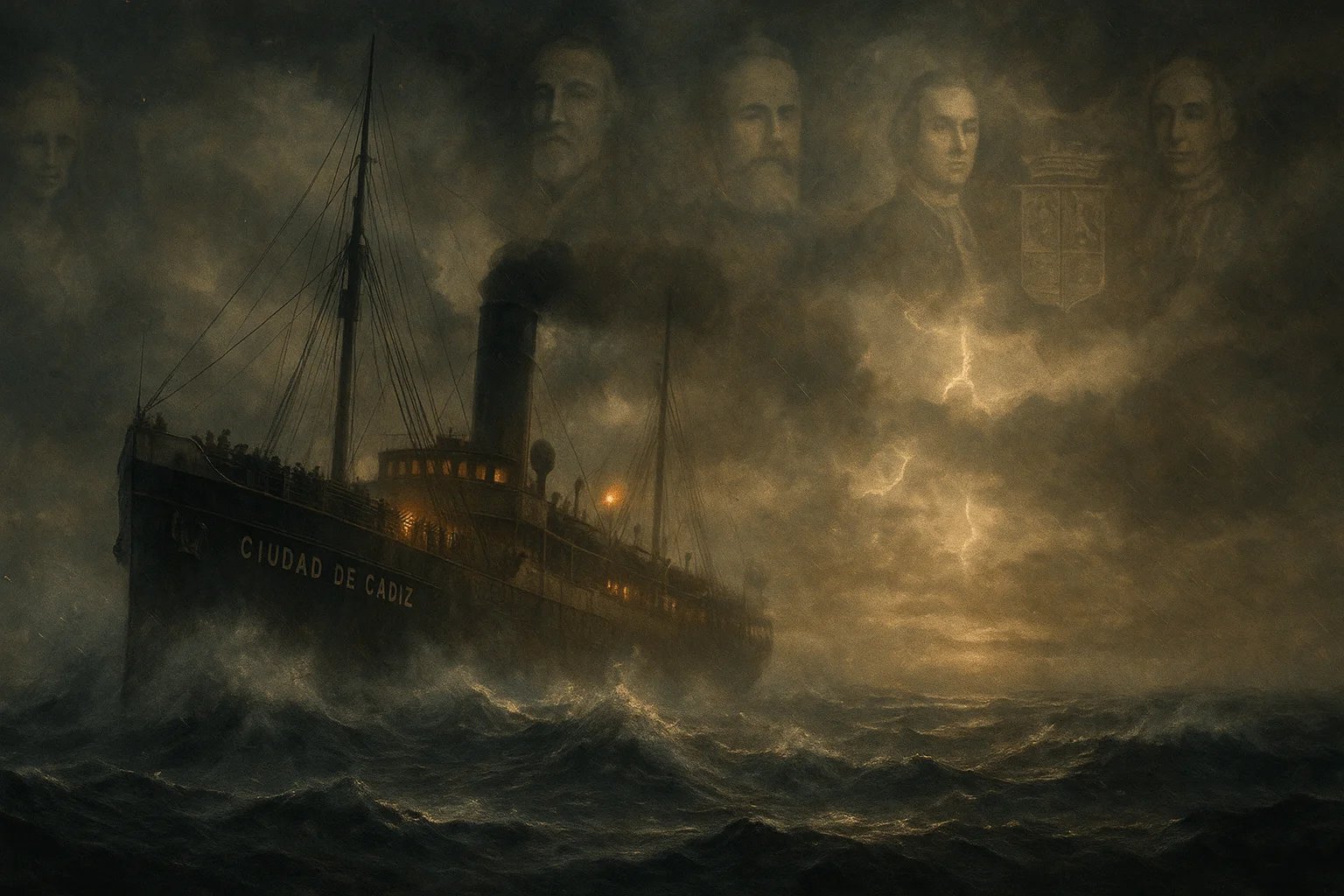
How a 1921 shipwreck preserved a 17th-century lineage and transformed it into a movement for art, dignity, and memory. The ocean does not always take. Sometimes, it returns. In October 1921, the Spanish steamer Ciudad de Cádiz sank between two worlds — the Old and the New — carrying with it not only passengers, but centuries of memory. From its rescue emerged a survivor who unknowingly carried the blood of knights, governors, and marquises: Manuel María Ponte Machado. A hundred years later, his descendant, Omar Bustillos Palis, would uncover the lineage and turn it into something profoundly human: Exodus & Resilience — a project that redefines nobility through empathy.
E&R Team
11/6/20254 min read
1. A Line Written in Salt and Ink
When genealogists trace the House of Ponte, they begin not in America but in the Atlantic — in Tenerife, where in 1496, a Genoese merchant named Cristóbal de Ponte financed the final conquest of the Canary Islands under the Catholic Monarchs.
For his service, he received lands, estates, and a noble legacy that would weave through generations of explorers, clerics, and officials across the Spanish Empire.
By the 18th century, this lineage had intertwined with other illustrious houses: Mijares de Solórzano, Tovar, and Peláez, producing descendants who held both pen and sword.
One of them, Esteban de Ponte y Blanco, was admitted to the Order of Alcántara in 1769 — one of Spain’s most ancient military orders, whose admission required proof of noble blood over four generations.
Another, María Josepha Teresa Mijares de Solórzano y Tovar, was granddaughter of Juan Mijares de Solórzano, first Marquis of Mijares, ennobled by King Charles II in 1691.
This network of alliances — preserved in brittle parchment at Madrid’s Archivo Histórico Nacional — tells a story of both privilege and perseverance.
And yet, by the 20th century, those titles had become silent, their descendants scattered by wars, revolutions, and the great Latin American migrations.
2. The Last Heir Who Never Knew He Was One
In 1921, Manuel María Ponte Machado boarded the Ciudad de Cádiz in Spain, unaware that he carried in his veins centuries of nobility and responsibility.
His father, Manuel María del Carmen Ponte y Domínguez, was a descendant of Manuel María de Ponte y Peláez — himself grandson of Antonio José Ponte y Mijares de Solórzano.
This last name, Mijares, linked them directly to the Marquisate of the same name, whose succession was recognized by royal decree in the late 1600s and reaffirmed in the 18th century.
But for the young Venezuelan, none of that mattered aboard the ship.
He was just another traveler seeking opportunity — until the engine exploded and history intervened.
The rescue off the Antilles, carried out by the SS Monterrey, diverted the survivors to Tampico, Mexico. There, in the heat of the port, destiny changed its course.
He met María de la Luz Loria Ortiz, and through that meeting, the noble lines of Europe merged with the migratory blood of the Americas.
From that union would descend a new generation that carried nobility not as privilege, but as purpose.
3. The Vanished Title
The title of Marquis of Mijares, granted by Charles II to Juan Mijares de Solórzano, had gone dormant by the 19th century.
Its documentation — including the Real Cédula de Merced and proof of succession through the Tovar family — rests today in the archives of the Spanish Ministry of Justice, awaiting rehabilitation.
For decades, the name vanished from public record, surviving only in genealogical manuscripts, family bibles, and notarized fragments scattered between Caracas, Tenerife, and Valladolid.
When the 21st century arrived, the line remained unclaimed — not because it was lost, but because the modern world had forgotten how to look backward with respect.
In 2024, researchers working with Exodus & Resilience’s Genealogical Archive cross-referenced documents from the Archivo de la Real Chancillería de Valladolid, Archivo de Órdenes Militares (Toledo), and Archivo General de Indias to confirm continuity between the Ponte and Mijares branches.
What emerged was not merely a family tree — but a map of resilience stretching across oceans.
4. Reclaiming Nobility Through Meaning, Not Privilege
In 2025, Omar Bustillos Palis initiated proceedings under Real Decreto 222/1988 to rehabilitate the Marquisate of Mijares, not as a claim to grandeur, but as an act of historical justice.
The petition — supported by genealogical experts, notarized records, and lineage tracing — is part of a broader mission: to demonstrate that genealogy can be a tool for cultural identity and human empathy.
“When we restore a title,” Bustillos explains, “we are not exalting a name — we are restoring continuity, dignity, and belonging.”
Through Exodus & Resilience, that restoration expands beyond nobility.
Artists who fled war, scholars in exile, and children of displacement find a symbolic home in the same archives that once preserved royal decrees.
In this sense, the marquisate becomes a metaphor for humanity’s resilience: every displaced person carries within them a title — not of land, but of survival.
5. The Art of Lineage
In the project’s exhibitions, The Ship That Saved a Marquisate is more than a story — it’s an installation.
A digital projection shows the ship drifting in the Caribbean, while an interactive display reveals the genealogical links between the Ponte, Mijares, and Loria families.
Beside it, contemporary artworks by diasporic artists reinterpret coats of arms with the visual language of migration — torn passports, salt, clay, ink.
The concept: heritage as fluid as the sea.
This dialogue between past and present defines Exodus & Resilience’s curatorial vision:
to transform archives into empathy, and ancestry into activism.
6. The Line Continues
Today, the Ponte–Mijares lineage lives through people, not papers.
Through the descendants of María de la Luz Ponte Loria, the family reconnected the scattered fragments of history that once linked Cádiz to Caracas, Tenerife to Tampico.
And with them, Exodus & Resilience honors every refugee, migrant, and artist who rebuilds identity from loss.
The project’s motto — “Empathy Through Art” — now echoes the same vow made by knights centuries ago:
to defend the dignity of others.
7. Epilogue: Nobility Reimagined
When the sea took the Ciudad de Cádiz, it did not erase a name; it redefined it.
The noble title of Marquis of Mijares may return to Spain’s official registry — but its true restoration happened long ago, every time an artist painted exile as beauty, or a migrant turned memory into strength.
Nobility, after all, is not inherited. It is practiced.
Sources & References
El Imparcial, Madrid (25 Oct 1921).
Archivo Histórico Nacional (España), Sección Órdenes Militares, Alcántara Exp. 97.
Archivo de la Real Chancillería de Valladolid, Expediente Ponte y Mijares, 1793.
Archivo General de Indias, Contratación 5447.
Guía Oficial de Grandezas y Títulos del Reino, Ministerio de Justicia, 2025.
FamilySearch.org, registros de Caracas y Mérida (s. XIX–XX).
Entrevista con Omar Bustillos Palis, Barcelona, marzo 2025.
Conectando arte, cultura y comunidades para el cambio.
© Exodus & Resilience. Todas las imágenes © de sus respectivos artistas. Prohibida su reproducción, extracción de datos o creación de conjuntos de datos sin autorización por escrito.
Exodus & Resilience desarrolla programas culturales estructurados en colaboración con socios institucionales y corporativos, bajo estándares claros de gobernanza y reporte.
Este proyecto se alinea con los Objetivos de Desarrollo Sostenible (ODS) de las Naciones Unidas.