
Cultural access
Participation, audience diversity, continuity of attendance and reduction of access barriers, when program data exists.
Framework page · version 1.1 · last editorial update: June 2026
This page presents the measurement framework for Exodus & Resilience in its founding phase. It explains what will be measured, how data will be verified and which claims are not yet being made.
This page remains accessible for institutional transparency purposes. It is a framework page, not an audited impact report or a final signed document.
Definitive indicators will be published only when each chapter has entered implementation and the corresponding evidence has been collected, reviewed and contextualized.
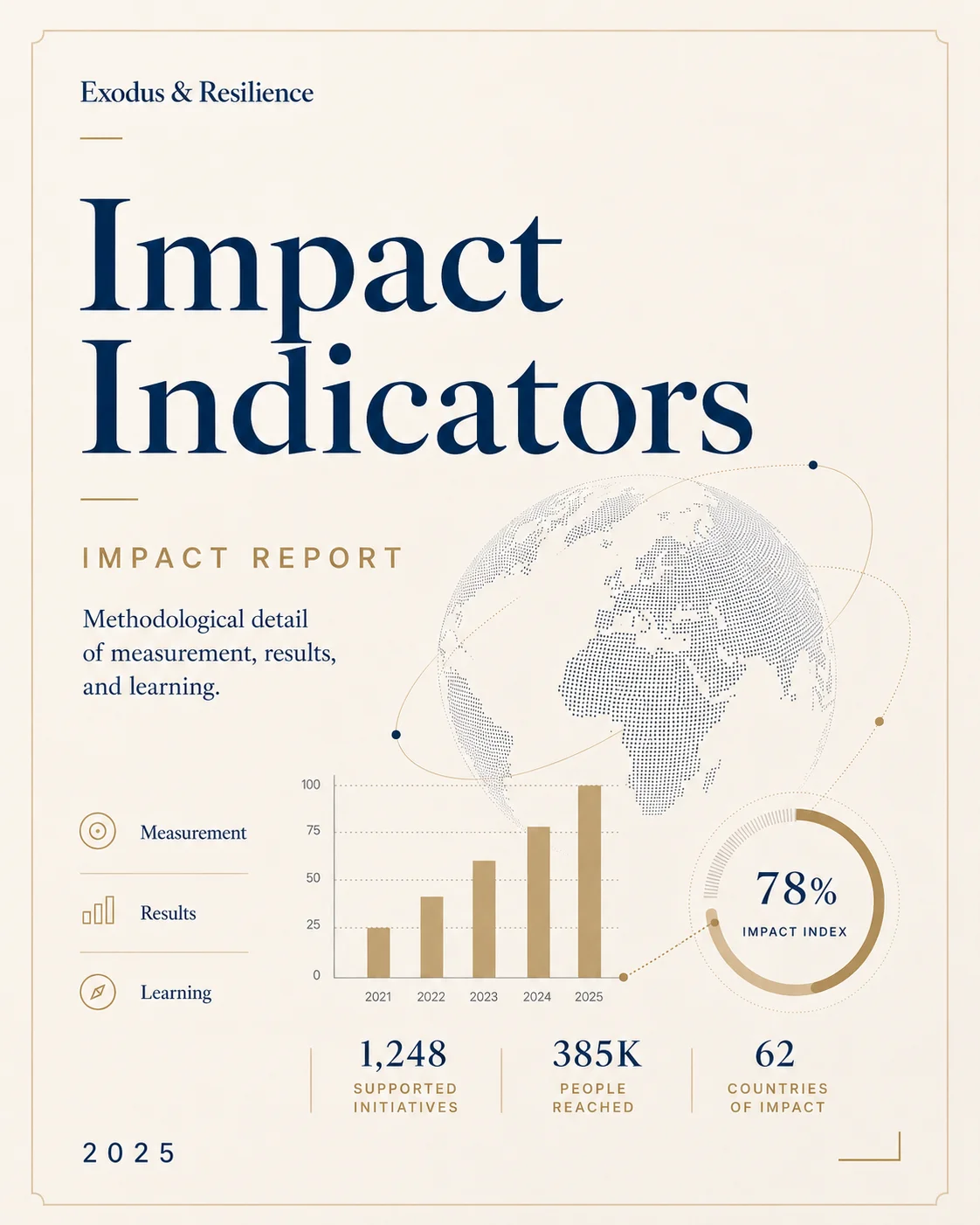
The Impact Indicators document is conceived as the future reporting framework for measuring cultural, educational, archival and social outcomes across the Exodus & Resilience ecosystem.
The current ecosystem is articulated through three founding chapters: New York/Venezuela, Caracas and Acarigua. Each chapter will generate its own evidence according to its context, partners, activities and verification capacity.
If you need a definitive, signed and dated version for institutional due diligence, you may request it at contact@exodusandresilience.org.
Document download: the definitive PDF will be published when the indicators have been dated, versioned and approved through the applicable governance process.
Exodus & Resilience is currently in its founding phase. Before reporting program outcomes, the platform is building the institutional architecture required to make impact verifiable, traceable and useful for communities, partners and donors.
This framework page does not report aggregated results, beneficiaries, direct participants, artists, workshops, training hours, public events or chapter-level outcomes. Those indicators will be published only when program activity exists and the corresponding data has been verified.
The platform applies a common measurement framework to the three founding chapters while allowing each territory to document evidence according to its own cultural, institutional and operational context: diaspora, origin and inland territory.
Participation, audience diversity, continuity of attendance and reduction of access barriers, when program data exists.
Hours delivered, workshops, residencies, mentorships, educational resources and methodological transfer, once each chapter is active.
Activities, exhibitions, publications, archives, audiovisual records and case studies documented by program cycle.
Perception of belonging, continuity of participation, relationships between actors and structured testimonies, with informed consent.
Foundations, universities, companies, cultural institutions, museums and territorial organizations involved in each chapter.
Data source, measurement owner, update date, verification method and identified limitations.
Testimonials from participants and communities will be published only with written informed consent and appropriate safeguarding criteria.
Impact measurement is connected to the six-stage methodology of Exodus & Resilience. Each indicator must emerge from a documented process rather than from isolated communications needs.
Exodus & Resilience identifies eight Sustainable Development Goals as a reference framework: SDGs 3, 4, 5, 8, 10, 11, 16 and 17. The platform does not yet report impact against these SDGs; future contributions will be published only with sufficient evidence and methodological context.
Culture, belonging and community cohesion as factors to be observed in relation to subjective well-being.
Training, residencies, workshops, cultural mediation and public knowledge.
Equity in participation, leadership, visibility and curatorial practice.
Professional opportunities for artists, mediators and researchers when program activity exists.
Cultural access and participation by migrant, diasporic and underserved communities.
Territorial cultural activation, decentralization and spaces for encounter.
Transparent governance, ethical frameworks, memory, documentation and accountability.
Cooperation with foundations, universities, companies, cultural institutions and local partners.
Each future indicator should identify its source, measurement period, responsible owner, verification method, territorial context and methodological limitations.
Cultural and social impact evaluation requires prudence. Exodus & Resilience does not present causal claims it cannot document.
The current baseline is institutional, not programmatic. It describes the architecture that makes future measurement possible.
New York/Venezuela, Caracas and Acarigua defined as complementary frameworks: diaspora, origin and inland territory.
VAEA for New York/Venezuela, and Fundación Museo de Arte Acarigua-Araure as implementing institution for Acarigua.
Caracas remains in design, support-reference and institutional conversation phase.
Strategic direction and public documentation are coordinated through the global institutional platform.
Six-stage methodology published as a common framework for the three founding chapters.
SDGs 3, 4, 5, 8, 10, 11, 16 and 17 are used as a methodological reference, not as verified outcome claims.
These are founding-phase milestones, not evidence of program impact. Program indicators will be published only when each chapter enters implementation, with its verification methodology.
The definitive Impact Indicators document will not publish estimated, decorative or aspirational figures as verified outcomes. It will include program data only when each chapter has entered implementation and the corresponding evidence is available.
The definitive version of the Impact Indicators document will be published as a downloadable PDF when dated, versioned, validated and approved according to the applicable governance process.
Until then, this framework page communicates the document’s intended structure, methodological criteria and reporting limits.
Base texts or additional clarification for institutional due diligence may be requested at contact@exodusandresilience.org.
Framework page · version 1.1 · last editorial update: June 2026.
The final document will be published when the first operating cycles generate verifiable evidence, validated data and documented limitations.